
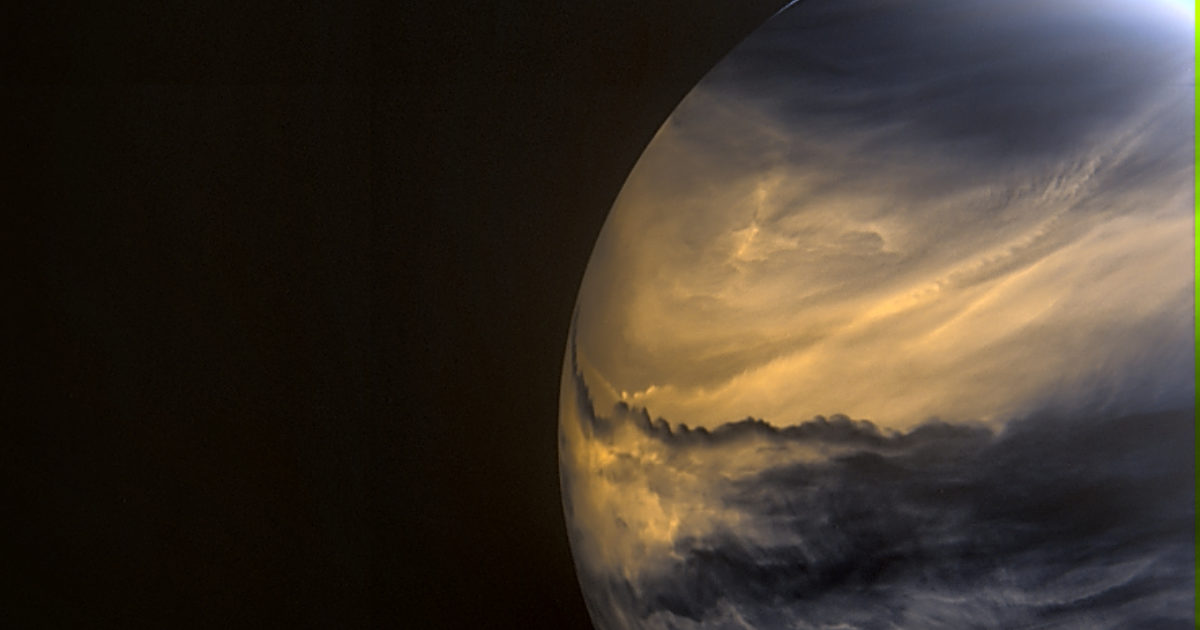
Funding from the 2025 programme “Use of space infrastructure for Earth observation and planetary research (GO)” will be divided among nine research projects focusing on two themes: Earth observation research and research into planets and other objects within our solar system. NSO and NWO (the Dutch Research Council) have granted more than €3.3 million to six projects in the field of earth sciences and three in planetary science, covering topics such as the atmosphere of Venus and Jupiter’s icy moon Ganymede.
All researchers make substantial use of space infrastructure such as satellites for their projects. These facilities are developed and maintained by various national and international space agencies and institutions. The infrastructure, and the data and signals it produces, are available to scientists and other users. Together with the Netherlands Space Office (NSO), NWO encourages Dutch researchers to use this infrastructure within the framework of the accompanying space policy of the Ministry of Education, Culture and Science. The following projects in planetary science have been granted, in alphabetical order of the main applicant:
Enhancing planetary missions with PRIDE – from past observations to the JUICE mission
Dr. ir. D. Dirkx (TU Delft)
Measuring how spacecraft move around other bodies in the solar system facilitates a better understanding of these bodies’ interior workings, as well as learn about their origin and evolution. In this project, we will further develop a technique from radio astronomy called PRIDE, which can be used to improve such measurements. Among others, our project will produce improved results for the motion of Mars, Venus and Jupiter, and a better understanding of Mars’ largest moon Phobos. Moreover, our work will enhance future missions such as ESA’s JUICE mission, which will study subsurface water oceans icy moons.
Beyond 1D: Unveiling 3D structure in Ganymede’s Interior using Juice
Dr. ir. M. Rovira-Navarro (TU Delft)
Ganymede, the largest moon in the Solar System, hides a vast ocean beneath its icy surface—making it one of the most intriguing places to search for life beyond Earth. This project will help us understand the structure of this hidden ocean world in 3D, using data from ESA’s upcoming Juice mission. By simulating how Ganymede’s icy shell behaves and how it affects gravity and shape, we aim to reveal what lies beneath the surface—and how Juice can detect it. The results could reshape our search for habitable environments in the outer Solar System.
Revealing Venus’ lower atmosphere through novel high-pressure/temperature experiments: a new framework for upcoming Venus missions
Dr. E.S. Steenstra (TU Delft)
The short- and long-term atmosphere evolution of our sister planet Venus remains highly enigmatic. However, Venus offers key insights into planetary evolution and greenhouse climate dynamics. The dynamics and chemical evolution of the lower atmosphere remains particularly poorly constrained. Here, I propose to address this by conducting new atmosphere-surface rock interaction experiments and dynamic atmosphere experiments at Venus relevant pressure- and temperature conditions. These novel experiments will provide crucial insights into the chemical and structural evolution of the lowermost atmosphere, and therefore, will yield the geochemical framework required for the numerous upcoming explorative missions to Venus.
Source & further reading: Nine new projects for Earth and planetary research launched (NSO), Over 3.3 million granted to nine Earth observation and planetary research projects (NWO), NWO funding for three planetary science projects (TU Delft)
Image: JAXA / ISAS / DARTS / Damia Bouic