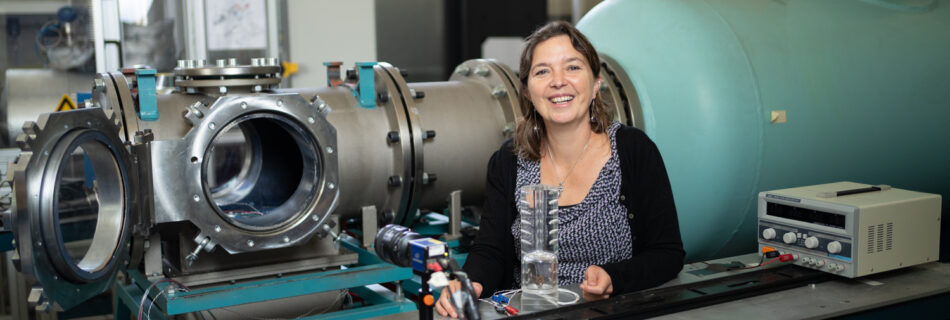
ERC Advanced Grant for unveiling the hidden oceans of Jupiter and Saturn’s moons

The oceans of several moons orbiting Jupiter and Saturn are considered among the most promising environments for finding extraterrestrial life. Buried beneath kilometres of ice, the moons’ surfaces may carry crucial information about the oceans below. Dr. Stéphanie Cazaux has received an ERC Advanced Grant to study the interaction between the moons’ oceans and their …

Rocky Worlds 4 to be held in Groningen 2026

Applying the detailed empirical understanding gleaned from the terrestrial planets of our own Solar System is crucial in our interpretation of exoplanetary systems. The Rocky World meeting series will help build the collaborations that will pave the way for the next decade of rocky exoplanet discovery and characterisation. The next Rocky Worlds 4 meeting will take place …

Europlanet Science Congress 2026 in The Hague

From 6-11 September 2026 the Europlanet Science Congress (EPSC) will be organised in the Amare venue in The Hague. The 2026 edition marks the first time that this major European meeting will be held in the Netherlands. The event brings together 900-1200 attendees from various planetary science backgrounds from Europe and beyond. The two co-chairs …

Two new calls to support previous Expertise Networks and Principle Investigators in space-based research

The Netherlands Space Office (NSO) has announced two new calls targeting proposals for extending Expertise Networks and supporting Principal Investigators. 1. Call for expertise networks The first new call for proposals targeting the support of existing Expertise Networks has been opened: ‘Strengthening knowledge cooperation in space research‘. This programme aims to support Expertise Networks whose …

PhD defence: Dynamic planetary hillslopes, Lonneke Roelofs

Summary: Mountainous areas and hillslopes on both Earth and Mars are actively being eroded by various sediment transport processes. On Earth, one of the dominant processes causing change on hillslopes are debris flows. These fast-moving masses of soil, rock and water carve deep valleys and transport sediment from mountain peaks to the valleys. How debris …

TU Delft researchers receive NWO funding to study life on icy moons

Stéphanie Cazaux and Niels Ligterink have received funding from NWO under the National Science Agenda (NWA) for their research project “The Search for Life on Icy Moons.” This project, part of NWA Route 15: Origins of Life – on Earth and in the Universe, focuses on how to sample material from the plumes escaping Enceladus’ …

Edgar Steenstra wins 2025 Vening Meinesz Prize

Edgar Steenstra from TU Delft has been awarded the Vening Meinesz Prize for Earth and Environmental Sciences. He receives the €10,000 prize for his innovative research on the formation and evolution of planets, particularly Venus and the Moon, as well as his role in international planetary missions. The award was presented on 20 March 2025 …

TU Delft launches Space Engineering labs including the Delft Planetary Laboratories

TU Delft is expanding its space research capabilities with the launch of four new and upgraded Space Engineering laboratories. These state-of-the-art facilities will provide researchers, students, and industry partners with advanced tools to push the boundaries of space exploration, planetary science, and satellite technology. Each laboratory serves a distinct purpose, from simulating extreme planetary environments …

Artist's impression of a volcano erupting on Venus. Whether Venus really is active today is a hot topic in planetary science. Source: ESA

Experimental insights into the origin of the largest lava river flows on Venus

The NWO Domain Board Science has awarded twenty-one grant applications in the Open Competition Domain Science-M programme. M-grants are intended for innovative, high-quality, fundamental research and/or studies involving matters of scientific urgency. One of these projects was awarded to Dr. Edgar Steenstra (TU Delft) to invest in lab facilities study the origin of the largest …

Kick-off for expertise network that will study habitability of planets and moons

How can we detect if a planet or moon has the potential to harbour life? A new expertise network funded with 690 kEuro by the Netherlands Space Office will allow a consortium of Dutch researchers to find out during the next five years. The involvement of various research groups illustrates the broad, interdisciplinary nature of …

PRELIFE consortium receives NWA funding to investigate the origin of life

The interdisciplinary research consortium PRELIFE has been awarded an NWA grant by the Dutch Research Council (NWO) to investigate the origin of life on Earth and in the universe, one of science’s greatest unsolved puzzles. The consortium will receive €6.7 million to explore this question and comprises scientists from sixteen universities and research institutes across …