
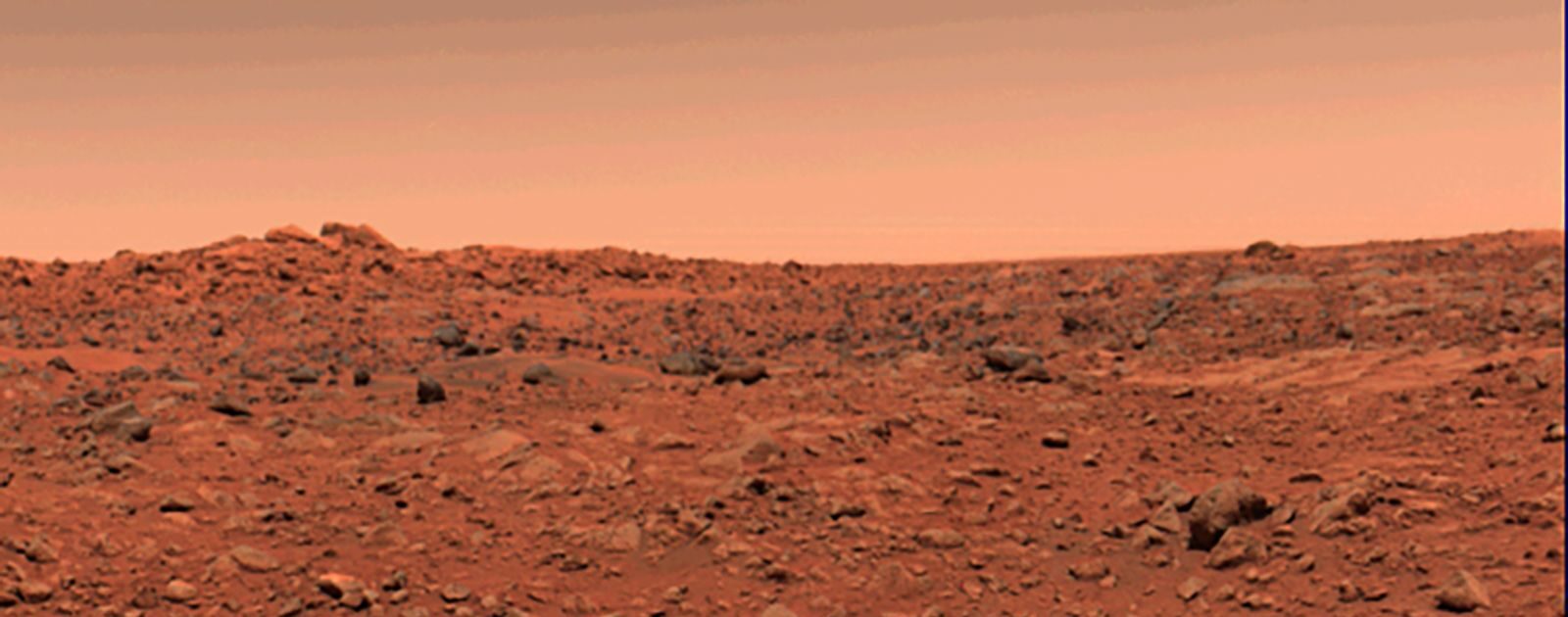
Exactly 50 years ago on 20 July 1986, Viking 1 landed on Mars. The spacecraft was part of the only mission ever to have searched for extraterrestrial life. With calls growing for humans to be sent there too, astrobiologist Prof. Inge Loes ten Kate is calling for a new unmanned life-detection mission. “Before our presence might make it harder to identify any Martian life, or even destroy it.”
Viking 1 carried three instruments capable of measuring biological activity and an analytical instrument (gas chromatograph-mass spectrometer, GCMS) designed to search for organic molecules. The readings from the three biological instruments could all be interpreted as indications (though not yet conclusive evidence) of life. The GCMS detected chloromethane compounds. These were interpreted at the time as residues of cleaning agents rather than Martian molecules. Conclusion: no life had been found on Mars, and since then there has been no direct search for life there. Case closed?
Chlorine salts
“I think the instruments that measured biological activity may well have been right.” Ten Kate points, for example, to the discovery of chlorides on the surface of Mars by the Phoenix Lander in 2009. “When the Viking experiments were repeated on Earth using chlorine salts, it turned out that these salts reacted with the organic molecules found in the soil samples and produced the same results as those measured by Viking. This means that the chloromethanes detected by Viking did indeed come from Mars.” In 2015, the Curiosity Mars lander found the same result as Viking. Following this, NASA engineers remotely adjusted the measurement method. Since 2018, Curiosity has also been detecting organic molecules. “More and more researchers are saying now that Viking’s other results may also have been correct.”
New instruments
So was life on Mars discovered 50 years ago after all? “The best way to test this is to go back with new instruments capable of detecting life. But we’ll have to act quickly, before humans might be walking around on Mars. Because all the research to date suggests that Martian life, if it exists or has ever existed, is similar to that on Earth, but adapted to Martian conditions. It will consist of the same carbon-based molecules. And as soon as there are people on Mars, it will become much more difficult to be certain that the life you’re detecting is actually Martian life, rather than something the humans themselves have brought with them.”
Caution
A new life-detection mission also requires the necessary precautions. “Of course, we don’t want to damage, or even destroy, any Martian life, if it exists. And we’ll have to think very carefully about exactly how we want to measure it, to avoid drawing incorrect conclusions this time.”
Drilling
In two years’ time, the ESA’s Rosalind Franklin rover will set off to conduct research on Mars from 2030 onwards, searching for traces of life. This lander can drill to a depth of two metres and is equipped with advanced instruments. “Although these cannot measure biological activity, this new mission will hopefully still be a step in the right direction.”
Viking archives
On 23 July, the book ‘Meet the Neighbours’ by Steven Benner, a leading American chemist who has pored over the Viking archives, will be published. This book offers a fascinating insight into how the Viking measurement process unfolded and provides the best summary of the Viking search for life currently available.
Source: We must resume the search for life on Mars as soon as possible, Utrecht University