
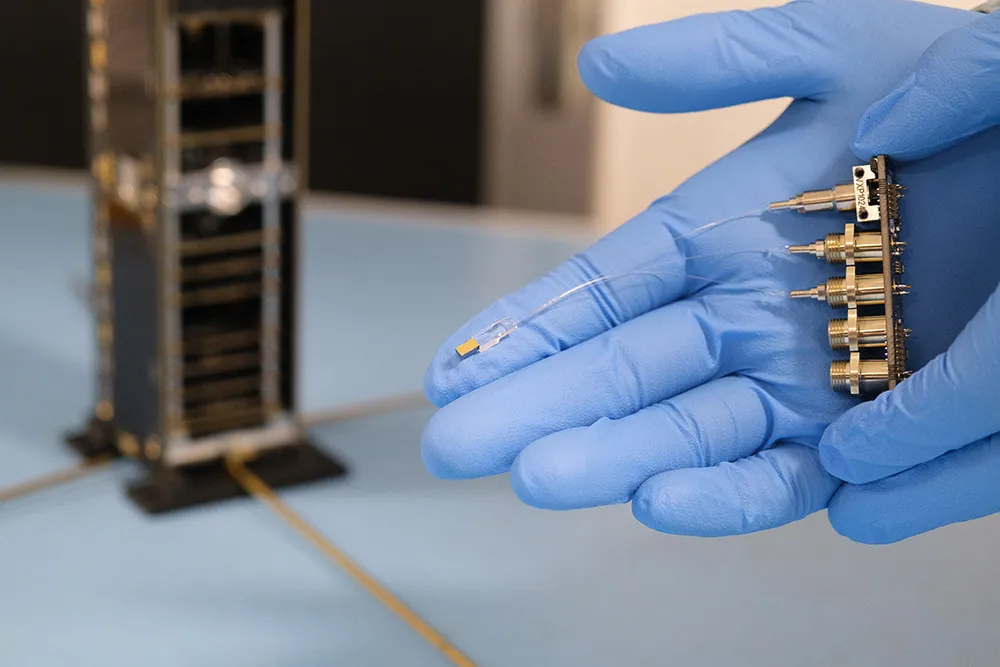
The Netherlands is a leader in both photonic chips and space technology. Now these two worlds meet, as two teams at TU Delft’s Faculty of Aerospace Engineering are joining forces. One develops miniature satellites, the other uses advanced photonic chips to search for signs of life. Together, they will bring a photonic sensing system from the lab to a TU Delft-built satellite. A real-life in-orbit demonstration. marks an important step towards technology that could detect signs of life beyond Earth.
The photonic chip at the heart of the Life Marker Chip (LMCOOL) programme will be tested in space for the first time aboard Delfi-Contact, an upcoming TU Delft PocketQube mission. The project is supported by the Netherlands Space Agency (NLSA).
Testing life-detection technology in space
At the centre of the mission is a photonic chip called PRISM (PocketQube Refractive Index Sensing Module). This chip technology forms the core of the Life Marker Chip (LMCOOL), which is being developed to detect molecules that could point to life, such as amino acids in liquids, by measuring tiny changes in the refractive index. Think of it as a keyhole: when the right molecular “key” comes along, the chip can recognise it, helping scientists identify possible signs of life. Dutch photonics company LioniX International will develop the PRISM hardware.
Source: From lab to space: TU Delft-led mission to test photonic chip in orbit